
Join us on our journey towards renewable energy excellence, where knowledge meets innovation.

Portugal and Spain share the Iberian Peninsula and the MIBEL electricity market, but their 2025 generation mixes tell two very different stories. Portugal soared past 80% renewable electricity, one of the highest penetrations in Europe, driven by wind, hydro and a growing solar fleet. Spain, while still impressively green at 56% renewables, relies more heavily on nuclear and gas.
These differences don't just matter for energy policy. They show up directly in the balancing fees that wind and solar generators pay when their forecasts miss the mark. Using hourly data from ENTSO-E and our internal pricing model, Synertics analysed these costs throughout 2025 to show how generation mix and system flexibility influence what renewables pay for imbalance in Iberia.



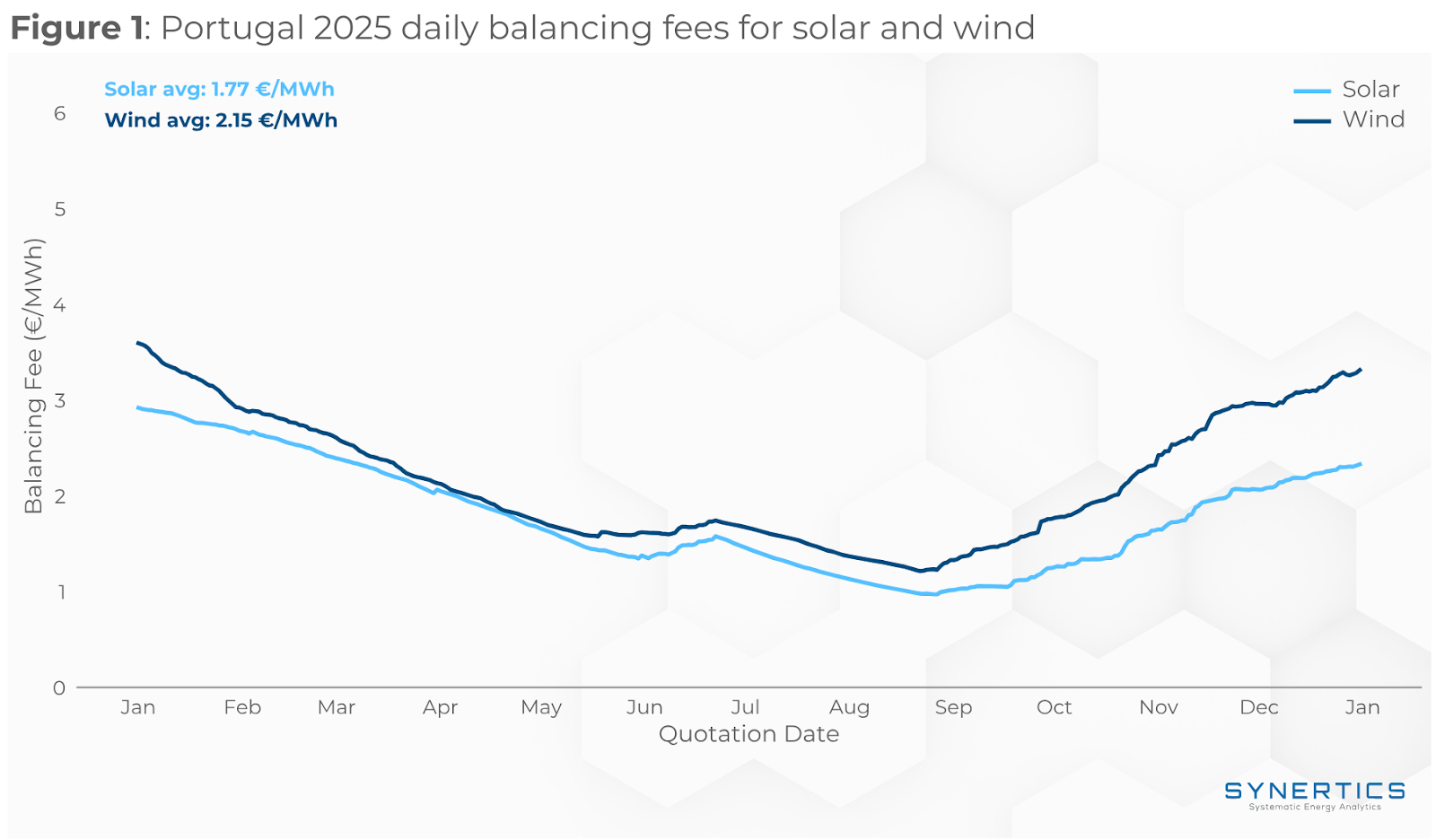
Figure 1 shows Portugal's daily balancing fees for 2025. A clear pattern emerges immediately: solar is consistently cheaper to balance than wind. Through the year, solar fees averaged 1.77 €/MWh while wind averaged 2.15 €/MWh, a gap of nearly 21%.
What explains this? The balancing fee is calculated from two components: the forecast error (how much actual generation deviates from what was promised) and the price difference between the day-ahead market and real-time imbalance prices (both up and down regulation). The imbalance price is determined by the system operator’s marginal cost of balancing. For under-generation, the operator must call on flexible assets like hydro or gas plants. For over-generation, it means curtailing other generators and compensating them for lost revenue. In Portugal, abundant hydro capacity provides low-cost flexibility that helps contain these imbalance costs. Solar's lower fees could reflect better forecast accuracy, but also that when solar does miss its forecast, it may tend to do so during periods when cheap balancing resources are available. Wind, by contrast, may experience errors during periods of higher system stress.
Across the year, both technologies move in sync. Balancing costs are highest in winter and fall sharply into summer, reaching just 0.97 €/MWh for solar and 1.22 €/MWh for wind by August. This decline reflects not only improved predictability, as summer weather patterns are generally more stable, but also a softer balancing regime: with abundant low-cost hydro flexibility (most pronounced from April through June, when reservoir discharge peaks), the spread between day-ahead and imbalance market prices narrows. As autumn sets in, rising uncertainty pushes costs back up again, reversing much of the summer decline, with fees more than doubling by year-end.
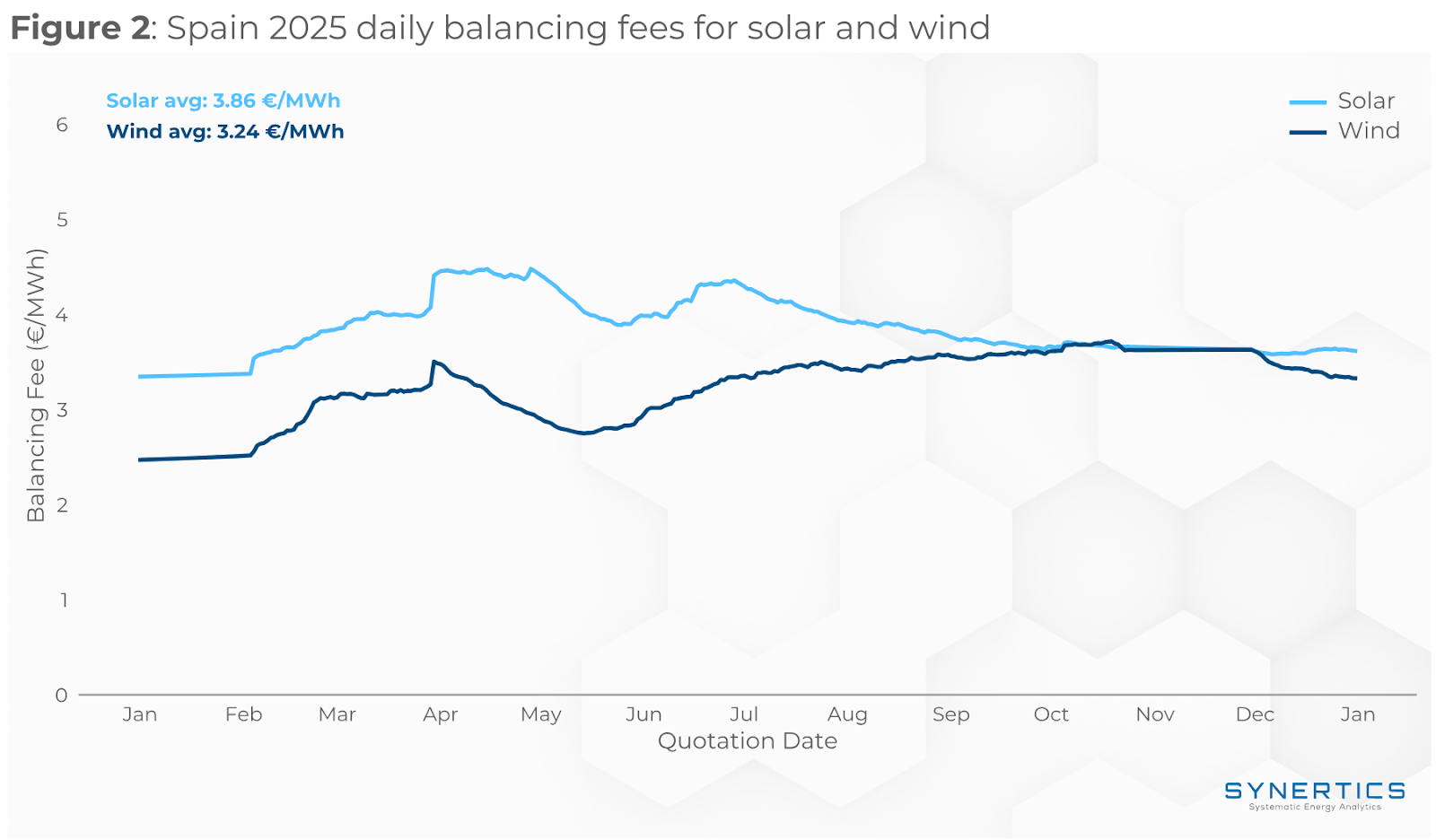
From what is shown in Figure 2, which presents Spain's daily balancing fees for 2025, a very different picture emerged. Unlike Portugal, where solar is consistently cheaper than wind, in Spain the opposite is true: wind averaged 3.24 €/MWh while solar averaged 3.86 €/MWh. Wind holds a 16% cost advantage over solar.
This gap suggests that wind benefits from greater forecast accuracy in Spain, while solar holds that advantage in Portugal, highlighting that forecast accuracy isn't inherent to a technology but depends on local conditions including climate and the quality of forecasting models.
A major regulatory shift occurred mid-year. On June 17, 2025, Spain integrated into the European PICASSO platform, enabling cross-border exchange of automatic frequency restoration reserve (aFRR) energy. This means Spanish balancing bids now compete with those from other European countries, with activations determined by overall system cost-efficiency rather than national needs alone.
The impact is visible in the data. After June, solar fees decreased slightly while wind fees increased, narrowing the gap between the two technologies. This suggests that access to a broader pool of balancing resources may have benefited solar more than wind.
Comparing annual averages, both technologies pay far more in Spain than in Portugal. Portugal's solar fees averaged just 1.77 €/MWh, less than half of Spain's 3.86 €/MWh. Wind follows a similar pattern: 2.15 €/MWh in Portugal versus 3.24 €/MWh in Spain.
The difference comes down to timing, not forecast accuracy. Despite similar average hourly price spreads in both countries (around 25 €/MWh in 2025), Portugal's generation occurs during hours when spreads are significantly lower. In Spain, generation is concentrated in higher-spread hours, meaning when forecasts miss, the penalty is larger.
This is reflected in the weighted spread, which measures the actual penalty per MWh of forecast error. For solar, Portugal's weighted spread was 13.2 €/MWh compared to Spain's 24.8 €/MWh. For wind, it was 15.0 €/MWh versus 22.0 €/MWh. In other words, when Portuguese generators missed their forecast in 2025, the penalty was roughly half of what Spanish generators paid.
Why does that timing difference exist? The answer lies in each country's generation mix.
Spain's annual electricity generation in 2025 (287.89 TWh) was more than five times that of Portugal (51.13 TWh). While scale may play a role, the composition of each country's generation mix offers a clearer explanation for the difference in balancing fees.
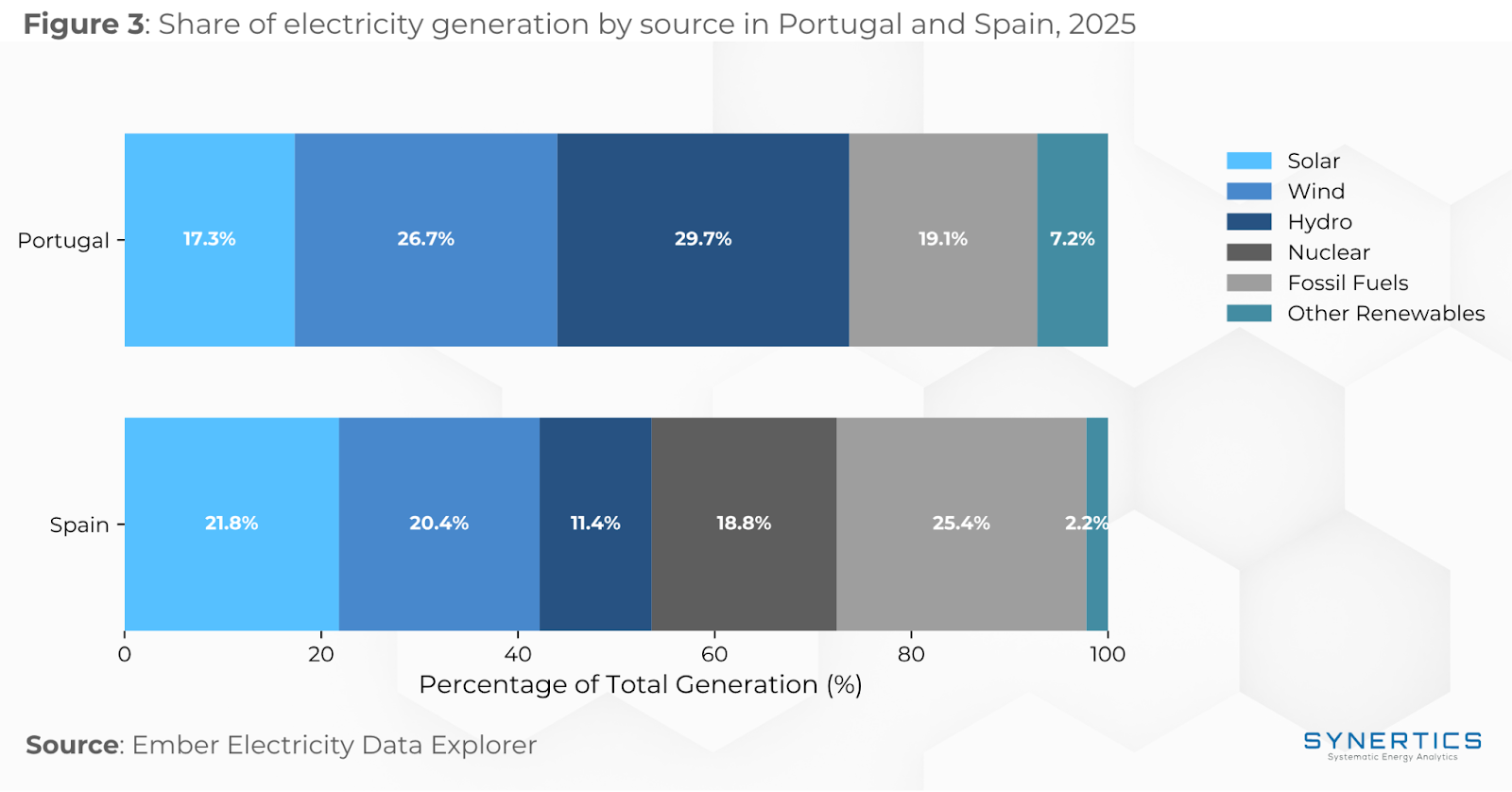
Portugal generated 80.9% of its electricity from renewables in 2025, while Spain trails at 55.8%. Portugal's renewables are led by hydro (29.7%) and wind (26.7%), with solar at 17.3%. Spain's mix is more solar-heavy (21.9%) but has less wind (20.4%) and significantly less hydro (11.4%).
That hydro gap is critical. Portugal's nearly 30% hydro capacity acts as natural storage, providing cheap, fast flexibility. When a generator misses its forecast, hydro can ramp up or down in minutes at near-zero marginal cost, collapsing the price spread between day-ahead and real-time markets.
The remainder of Spain’s generation mix explains why balancing costs remain high. Nuclear occupies 18.8% of its mix, while Portugal has none, providing steady baseload power but limited flexibility for short-term fluctuations. Fossil fuels, mostly gas, account for another 25.4% and can ramp, but at a steep cost. Without a sufficient hydro buffer, Spain's system relies on thermal plants when forecasts miss, keeping imbalance prices high year-round.
While both countries share a peninsula and a single wholesale market, their infrastructure creates different risk profiles. Portugal's hydro provides low-cost flexibility that contains imbalance costs. Spain's reliance on nuclear and gas leaves it more exposed to penalties for intermittency.
As European balancing platforms like PICASSO expand, Spain's costs may gradually converge toward Portugal's. But without a fundamental shift, more storage, more hydro or cheaper thermal flexibility, Spain will likely remain the more expensive regime.
The path forward for each country reflects these starting points. For Portugal, maintaining its cost advantage means managing hydro reserves carefully as solar and wind grow. For Spain, today's high balancing fees may themselves become the driver of change, accelerating investment in the battery storage needed to improve system flexibility and reduce balancing costs.

 3 min
3 min
Market-trends
14th Oct, 2026
6 min
Market-trends
14th Oct, 2026
2 min
Market-trends
1st Oct, 2026