
Join us on our journey towards renewable energy excellence, where knowledge meets innovation.

A battery in Spain does not depend on a single revenue source. It can capture energy arbitrage in the day-ahead and intraday markets and earn from ancillary services by providing aFRR and mFRR balancing to the grid operator (Red Eléctrica). Combining these streams, known as revenue stacking, is where much of the value lies. But each market pays on different terms, and a battery's power and energy can only be committed once in any given quarter-hour. So which markets carry the value, and how much does the stacking strategy matter? To find out, Synertics modelled what a battery could have earned in each market, and across all of them together, using actual prices from October 2025 to September 2026.



A battery in Spain can earn money in two ways.
Wholesale markets. The battery buys energy when prices are low and sells it when they are high. In Spain this happens in the day-ahead market, the day before delivery, and in the intraday markets, closer to real time.
Ancillary services. The system operator pays the battery to help keep the grid balanced, either for keeping power available (aFRR capacity) or for actually delivering or absorbing energy when called upon (aFRR and mFRR energy).
Comparing these markets fairly is difficult, because real batteries rarely publish what they earn, and each one follows its own strategy. Instead, we modelled a single reference battery against real market prices and calculated the most it could have earned in each market, and across all five at once.
The reference battery is a standard two-hour system:
1 MW power and 2 MWh energy
95% efficiency in each direction, about 90% round trip
At most one full cycle per day
State of charge kept between 5% and 95%, starting and ending each day at 50%
These parameters reflect a typical grid-scale lithium-ion battery: two hours of storage is a common configuration for new projects, and the limits on cycling and state of charge mirror the operating constraints that manufacturers set to limit degradation. Using 1 MW also makes the results easy to scale, since they can be read as revenue per MW of installed power.
The model works at 15-minute resolution. For each day, it decides how much the battery charges or discharges in every quarter-hour to earn as much as possible. For aFRR and mFRR, the model assumes the battery’s activation is always accepted, in the direction and volume that suit it best. In reality, the system operator activates only the volume it needs, choosing among competing providers, so a battery may not be called even when activation occurs.
| Strategy | Theoretical revenue (€), Oct 2025 – Sep 2026 |
| All markets combined | 162,926 |
| aFRR energy | 128,094 |
| mFRR | 75,551 |
| Intraday | 70,794 |
| Day-ahead | 66,873 |
| aFRR capacity | 42,570 |
Each single-market figure assumes the whole battery is dedicated to that market, so the rows can't be added together. The combined figure is what one battery could earn by splitting its power and energy across all five markets at once, respecting the same physical limits.
Two things stand out:
Balancing offers more than arbitrage. aFRR energy alone could have earned almost twice as much as day-ahead trading, although this relies on the battery being activated whenever it is profitable, which overstates what a real asset would capture. mFRR, which is only available in quarter-hours when the system operator activates it, could have earned more than either wholesale market. aFRR capacity is the exception: on its own, it was the lowest of the five.
Stacking markets adds value. Optimising the battery across all five markets could have earned 27% more than the best single market. A battery that commits to only one market leaves a significant part of its value unused.
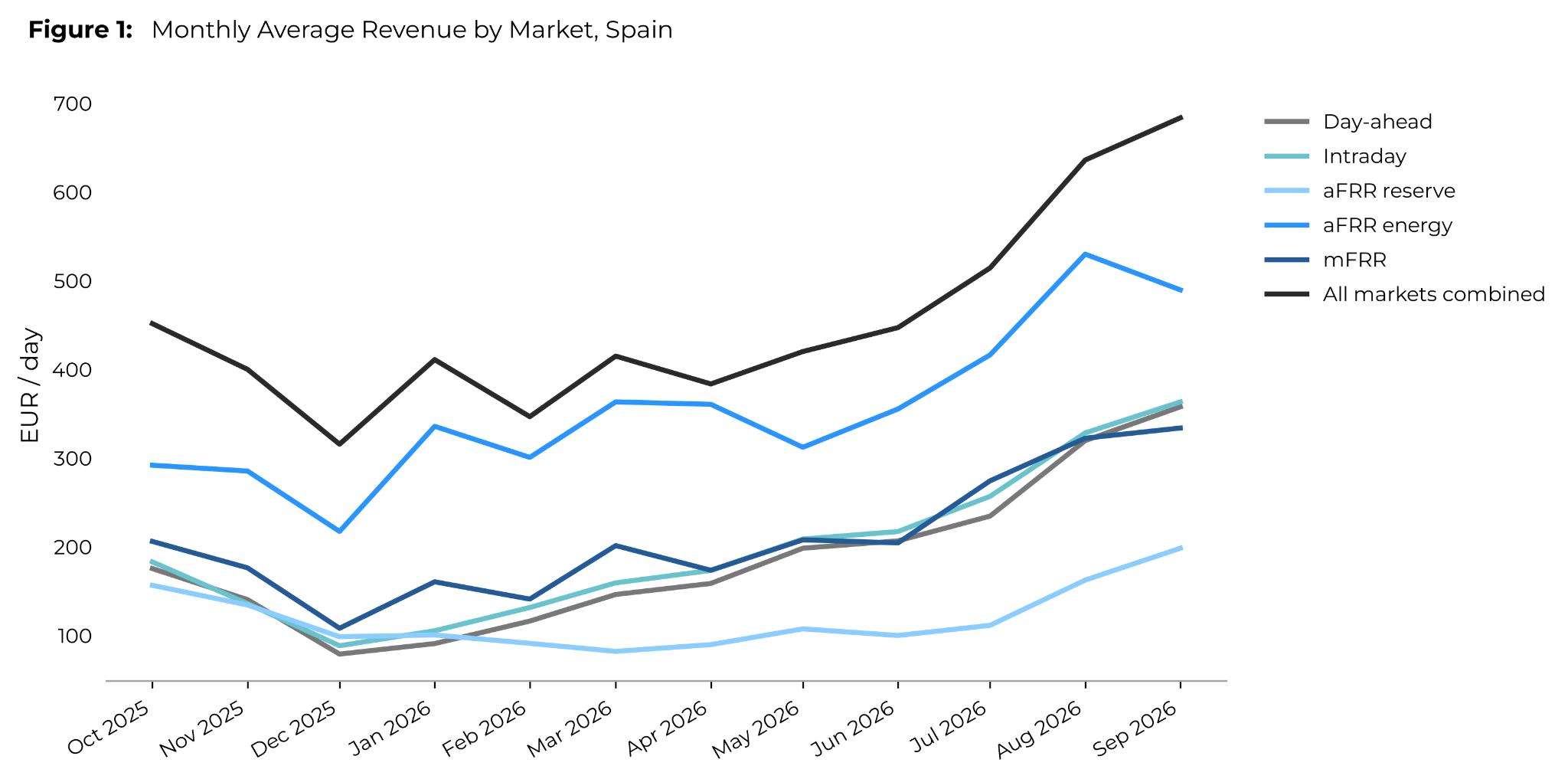
Looking at monthly averages of the daily results shows a clear seasonal pattern.
October 2025 to January 2026 was the weakest stretch. A battery active in all five markets saw its daily value fall from around €450 in October to €313 in December. Day-ahead alone was hit harder, dropping from €173 to just €76. aFRR energy held up best, still paying nearly three times as much as day-ahead in December. By January, being active in every market was worth 4.6 times more than trading day-ahead alone.
February to June 2026 was stable on the surface. The combined value held between roughly €340 and €450 per day, but the day-ahead revenue more than doubled between January and May, gradually closing the gap with balancing.
July to September 2026 offered the highest potential of the period. Every market rose in July and August, and the combined value passed €600 per day in August and September. Day-ahead grew fastest, reaching €355 in September, almost five times its December level. By September, combining all markets was worth 1.9 times day-ahead alone, down from 4.6 times in January. Day-ahead arbitrage on its own went from about a quarter of the combined value in December to more than half by September.
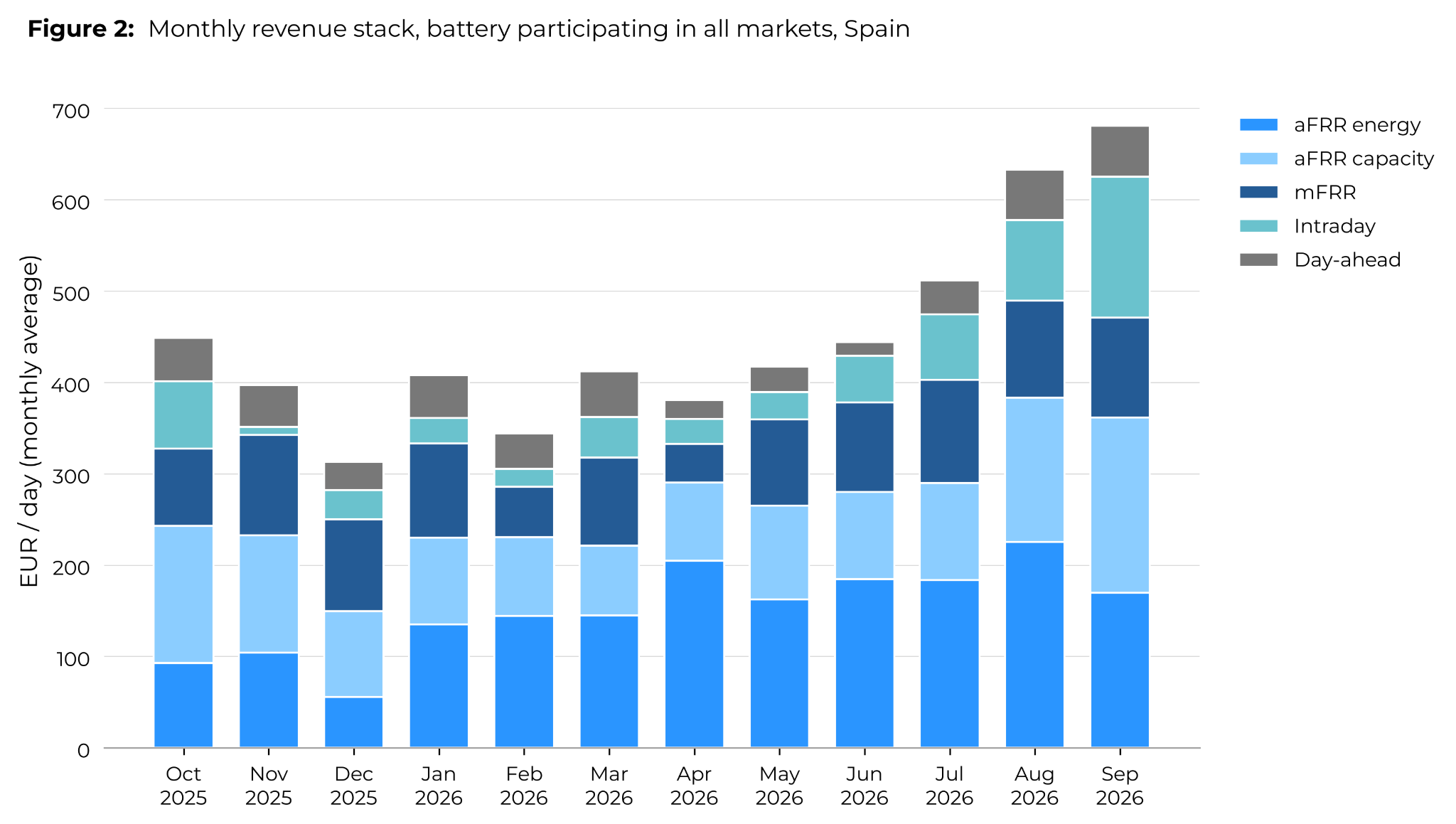
The chart above breaks down the all-markets result: in each month, how much of the battery's value came from each market when it could participate in all five at once. Unlike the single-market figures, these are not separate scenarios but parts of one optimised strategy, so they add up to the monthly total.
aFRR is the core of that strategy, providing between 48% and 76% of the value every month. Capacity led in the autumn months, while aFRR energy took over from January to August. mFRR added a significant share throughout the year, reaching almost a third of the total in December. Day-ahead remained a minor contributor at 3–12% per month, even as its standalone value rose through the summer, while intraday grew towards the end of the period and reached its largest share, 23%, in September.
The results above describe a best-case scenario. They are an upper bound on what the reference battery could have earned, not a forecast. The model assumes:
Perfect foresight: the battery knows every price for the day in advance.
Ideal activation: for aFRR and mFRR, activations happen exactly when the battery would have chosen them. In reality, the system operator decides when a battery is activated.
A real battery will earn less. How much less depends on forecasting, bidding strategy and operational constraints. These figures are still useful: they show where the value sits, and how that is changing, independently of any one operator's execution.
The results suggest that balancing markets hold a large share of the potential value for battery storage in Spain. Between October 2025 and September 2026, aFRR energy was the most valuable single market in every month, and a battery able to participate in all five markets could have earned around 2.4 times more than one trading day-ahead alone.
These figures are a theoretical ceiling, and they overestimate what a real asset would earn, particularly in the balancing markets, where actual activation depends on the system operator rather than on the battery. Even with that caveat, the gap between the single-market results is wide enough to indicate that access to ancillary services, and aFRR in particular, is worth serious consideration in a battery's revenue strategy.

 3 min
3 min
Market-trends
14th Oct, 2026
2 min
Market-trends
1st Oct, 2026
2 min
Market-trends
30th Sep, 2026